Politics and Faith Continued

Much continues to be written about the intersection of faith and politics. I was reading a piece the other day, the conclusion of which I’ll share in a bit. As one whose life of the mind exists in both of these worlds, I’m drawn into the relationship of these two powerful forces. I guess that should go without saying for anyone who has been reading these essays.

Anyway, at the risk of being way too simplistic, I sort of see this in two different ways. First, is the question of whether or not the two should mix. On this, I see some remarkable similarities between the traditional left and right. On the left, increasingly secular and in the extreme, virulently anti “religious” or atheist, the position is that faith has little or no standing in the contemporary world. In this telling, faith is synonymous with fantasy or vague mythology, certainly in contradiction to what every educated and scientifically literate person understands. On the right, populated as it is with people holding strong traditional values, mostly Christian, the position is increasingly one of considering withdrawal from the public life. In other words, the “culture wars” have been lost and “we need to hunker down in smaller enclaves” to live out the values we hold dear. Now, this chatter has not yet gained significant traction but it is emerging as a strong voice. Put together, these two basic suppositions are in contradiction to a long tradition in our country that faith and politics are deeply intertwined.

Second, though, is the debate on both left and right over just how faith and politics can intersect. Although it might come as a surprise, Americans continue to be distinctly “religious” as they self define their beliefs. By religious, I mean claiming affiliation with a particular faith system. A recent Pew report listed approximately 70% of Americans self-identifying with one of a large number of Christian denominations or unaligned Christian faith communities. Jews comprise 2% while Muslims, Buddhists and Hindus each claim about 1%. Unaffiliated comprise about 23% of which 3% are avowed atheists, 4% agnostics and 16% just don’t know. Now, Pew is a very reputable polling firm, especially on issues related to faith and belief. The data might give rise to all sorts of questions but I don’t want to go there right now.

Instead, I’m sharing this to show that, in our country, it’s really tough to get away from faith and, given the fact that most adult Americans have some strong opinions on at least one or more issues resolved in the political arena, the two forces have to interact.

All of which brings me back to the debate between left and right on just how the two should function together. I share these thoughts as a reflection based upon a lot of listening and reading; there is, after all, a lot of noise on the subject!

On the left, deeply grounded in concepts of social justice and diversity, the position regarding the intersection of faith and politics is more and more defined by the importance of including non-Christian voices in the debate. Increasingly, that means Muslim, as neither the Hindus or the Buddhists seem particularly interested in engaging in the political life in this country. As the ranking minority of non-Christian faiths, Jews have typically lined up more to the left, although issues related to Israel’s standing have created pointed disagreement. When it comes to left-leaning Christians (a large proportion of whom are Catholic), the position is heavily defined by the Social Gospel, the central theme of which is that Christians are called to help the needy in all circumstances (a deep grounding in the second of Jesus’ two commandments).

On the right, dominated largely by Protestant Christians but also including Catholics and Mormons, the collective position is more defined by values consistent with the institutions of family and small communities as well as a tight allegiance to scripture, (considered the Word of God) beyond the four gospels and including both the old and new Testaments. At the risk of over simplifying again, I’d just toss out that their position is more aligned with Jesus’ first commandment.

As the two sides lob grenades back and forth, charging one another with hypocrisy or radicalism, nationalism or un-Amercanism or all sorts of things, like everything else these days, the result is very unfortunate and an increasing polarization and viciousness that is draining and depressing.

After all, in the plain Christian world, Jesus is neither a Democrat or a Republican, neither a liberal or conservative, and it would be a mistake to think otherwise. In fact, he had some things to teach us about the intersection of faith and politics, a prime piece of which was played out historically over the recent period many Christians refer to as Holy Week or the Passion.

So, as I draw to a conclusion, without wanting to further dive into the weeds on all of this, I’ll return to the remark that brought me to this essay.

It was at the end of a piece by someone I read from time to time. He would be quite recognized as an observer of things political, with some pretty strong opinions. He was an outspoken opponent of both Trump and Clinton for all sorts of reasons. He is a practicing Christian who is in the process of changing the lens through which he examines important topics of the day. His shared recent health struggles have affected that lens, as many seriously considering mortality are wont to do.  Although I disagree with him on some things, I could identify with his final words.

“My time here is fleeting. So is yours. There’s no reason to hold on to grievances, no reason to avoid forgiveness, and no reason to devote our time to wasted idols. We are not all going to agree all the time on right and wrong. But life is too short not to show each other grace freely and move on.

This past year, I have recognized something important. The people who have turned politics into their god are the most miserable, malcontented people I know. Not everything is political and when you think it is, you have turned politics into religion. Life is not supposed to be political and death coming to visit me showed me how much more to life there is.”


London

One of my oldest and dearest friends is Dan. We have been incredibly close for over thirty years. Our families are so interconnected we actually are family. At a minimum, we spend every Thanksgiving, Christmas and Easter together and our children are as close as close cousins. We’ve had more celebrations than I can count and we have weathered more than a few heavy storms. We’ve lived a whole lot of life together and all love one another deeply. But that’s not why I’m writing.

While chatting with Dan at their house on the back patio after dinner last night, Dan shared a brief story. He has become close to another friend, with whom he shares both time and things important to both of them. His friend has a ten year old daughter. From the telling of it, this daughter is the light of his life. What ten year old daughter wouldn’t be?

She was recently diagnosed with a terrible form of stage four cancer. The path ahead is dark. The girl is a joy and has been one to breathe joy into the lives of many others, I understand. Not just her parents. Her name is London.

If you are reading this and are given to prayer, please pause now and lift up young London. Ask for healing in her body and strength in the hearts and minds of those who love and care for her. We give thanks for London and for her family and for the medical staff and for Dan and everyone who touches London’s life. We give thanks for dear friends and the ability to share agonizing burdens and for the knowledge that we are not alone in our suffering. We pray deeply for healing. Amen.

Susan

This morning, we gathered at Susan’s house as we do most Friday mornings and as we have been doing for three and a half years. I have written before about this group and what a special place it has in Diane’s and my lives. This morning stands out.

You see, dear Susan’s brain cancer returned with a vengeance this past month. Given an early prognosis in 2013 that she had not long to live, she has managed to defy all of the odds and not only live, but flourish, since then. Her disease has steadily receded, most miraculously; so at times, this group (founded as Team Susan and now frequently referred to as our Little Band of Believers) has often focused our attention elsewhere. Our prayers and conversations early Friday morning are wide-ranging as we’ve lived through tremendous joys and deep grief as well as the regular rhythms of normal life. Susan’s life and life of her family during this period is nothing short of a great testimony to love, faith and resiliency. The sudden recent news that she had begun experiencing regular seizures brought us back to a point we had largely relegated to memory. Now it was thrust right smack back to the front.

Fast forward to a little over a week ago, after a series of MRIs had shown large new growth of the cancer, to Susan undergoing seven hours of brain surgery. Honestly, she did not know if she would actually survive the surgery, but hoped fervently not only for survival but that she would have speech and other motor skills. The amount of prayer and love poured into her from family and friends, including our Little Band, is merely reflective of who Susan is and what her life has become.

Susan, after all, is living and infectious joy. Oh, she’ll admit to huge challenges and dark moments, forcing her to surrender in ways that most people can’t imagine. But, you just need to look at her beautiful smile that lights up her face and an entire room. You need to get one of her hugs where you know it’s not just a thing but a connection between two lives. You need to see how the people that revolve in and around the space near her transmit the love that she exudes and you’ll get a sense of who she is and what her life means.

After all, her life has meaning and it’s not just to get by. Nor is it to just get things done. Nor is it to achieve great things. No. That’s not what her life means. Susan’s life is about showing who Jesus is and there are not many who show that better.

She went into surgery a week ago Wednesday. We prayed over her and with her the day before, engaging in the ritual of anointment, with the oil signifying a bond with God. Before and during the procedure, many were at the hospital and close by, talking, walking, praying. Laying Susan before God, handing her over to his care. She woke up much later and, I understand, began talking almost immediately. She came home Friday. I’ll say that again. She came home Friday. After seven hours of brain surgery, she was walking around, animated and joyous the next day and then she was released.

While the details trickled in immediately, we learned later that the surgery was incredibly successful, excising a lot of the disease, leaving more chemo and radiation on the horizon to push back against the inoperable remainder. However, Susan told us today that she’s never felt better. She’s actually improved her physical condition to its best point since the original diagnosis. Hallelujah!

Today is called Good Friday. The origin of the word “good” in this context is not clear. However, the meaning of the day is. It’s the day when God incarnate surrendered fully in an act that defies all we can think of as reasonable. The meaning of the crucifixion and death of Jesus is way too complicated to get into here. For the longest time, I didn’t really understand it. Now, of course, I do. It’s fitting that our Little Band convened for the first time since Susan’s surgery on this day.

Because, of course, Susan has to surrender every day. She has to. Many of us don’t. But, she does. She’s had to surrender every day for going on something like forty-three months. And, as she well knows, she can’t do that alone. Yes, she has a family and support network of loving friends but the surrender she must ultimately perform is only accomplished with God’s help. She will tell you that. And, this is something that we who are close to her know and feel deep into our souls.

And, just as this is the day of surrender, it is also the precursor of the greatest miracle of all: the Resurrection. The lifting up into eternal life. And, just as Susan has been surrendering, if you could have seen her this morning, aglow as she was, you would have gained a glimpse of the true Resurrection.

We do not know what tomorrow will bring as we move through our lives. But, we can know what today or any day is all about. Most assuredly, it is largely not what we think it’s about each day. It’s not usually where our normal attentions are drawn. But, take a moment to consider what lies just beyond the veil and the answer shimmers through.

Thank you, Susan and the Millsom family, for inviting us into your lives and allowing us to share in all that that means. We are permanently altered for it. Praise God.

* * * * *

IMG_1125

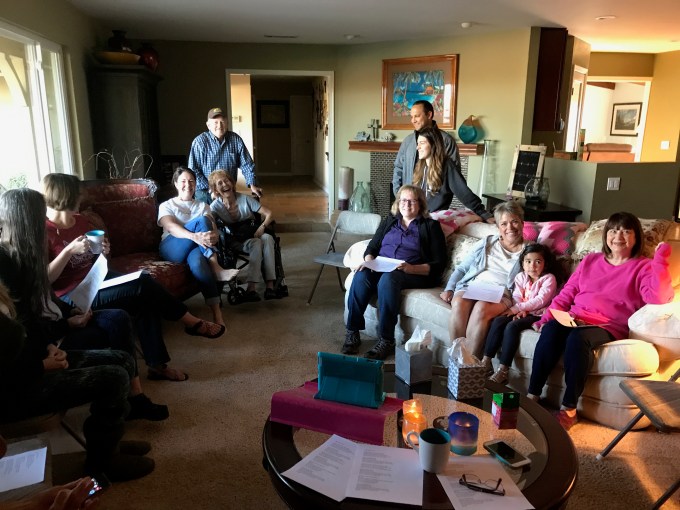
Here is a candid picture taken this morning of our group.  Susan is the lovely lady grabbing her knee, next to dear angel Connie who is beaming with joy. Connie’s husband, Rex, is standing behind her. Diane’s sister, Mary, is front left, with Diane sitting to her right and out of the picture. Next to Mary is recently-joined Ginger. Standing are Susan’s daughter, Stephanie and her husband, Joey. Joey’s mom and prayer warrior, Kelly, is seated beneath Stephanie. On Kelly’s left is sweet Mary, with her young friend and new attendee. Next to her is our dear neighbor, Jan. Unfortunately, some are not in the frame, including Diane, Kiki and Patty (sisters and forces of nature), other Diane (original team captain, now connected via FaceTime on the blue iPad), Susan’s husband, Andy, and Andy’s father, Mark. Regular attender Nancy is out of town, as is Susan’s daughter Drew. This is our Friday morning home.

Christians: A Bad Name?

It’s increasingly common. No. It’s way more than common. In places like coastal California, metropolitan New York, in northeastern enclaves, as well as most of Europe these days … the word Christian at best conjures up a shrug and at worst, a visceral and antagonistic reaction.

Let me qualify that statement. It’s not really the word Jesus that does it to that degree, although it certainly does at times. It’s the concept of Christianity. The concept of people who claim that as their faith.

In many circles, with the so-called educated elite and much of media, the first synonym that probably comes to mind is “hypocrite.” I’m just guessing. I’m also guessing that the next synonym might be “oppression” or “oppressive.”

I’ll say two quick things about that. The first is that these reactions are often completely deserved and appropriately descriptive.

The second is that they are SO off of the mark.

Heck Yes! We Jesus-followers have messed up a great deal. We always have and always will. In that, we’re no different from the followers of every other “religion” and from the followers of those who claim no faith or religion at all. Yes, we’re all the same. We’re all human and very flawed. All of us. There’s not a belief system in the history of our species that is not corruptible by human frailty. Not a one. And, lest we not be clear about this: The claim of no allegiance to a particular belief system because one is either uncommitted or committed to the idea that there is no such thing as a belief system or that the belief system has no room in it for a supernatural being … all of these claims are just plain belief systems. Just like the world’s so-called religions.

Yes, we Jesus-followers … we that sometimes refer to ourselves as Christians … have always struggled with hypocrisy. As has everyone else.

But, and here it gets interesting and I really want to make a point: How many other belief systems completely accept that that’s a problem with us? That we are, indeed, hypocrites? How many other belief systems have at their core two foundational principles: That we love God with everything we have (and I mean everything, not just most things), all the time. And, that we love one another with such complete abandonment that it reflects the same love that Jesus demonstrated time and time again towards everyone he came across, not matter how flawed or broken. Try that on for size. No other belief system commands that high bar. Not a one. Of course, we can’t do it. Really? Think about it. All sorts of belief systems have all sorts of standards but none of them (and I have looked at all of them) has these two at their core. None of them. Of course, we fall short.

Now, we Jesus followers have messed up more ways than we can list here. But, I’ll toss out an obvious one right now. We, far too often, are now being known for what we’re against rather than what we are for. It’s that simple. We make it easy for people to look at us as a curious or even repressive faith. Because that’s not what Jesus taught. He taught that we would be known for the way we loved one another. Not the way we categorized or judged one another as everyone else does. And, believe me, everyone does.

But here’s the deal. The world that sees Christians in this light does not know the Christians I know. If they did, they would be amazed. And not just lightly amazed but completely amazed.

I have been around a lot of people, all of my life, who have done “good” in this world and they represent many different belief systems from agnostic and atheist to adherents of many of the great faith traditions. But, I have never, never met a group who so consistently demonstrates the practice of those two foundational principles. Both of them.

I just spent two full days at a conference with about 4000 Jesus-followers. Nearly all of them were leaders in their faith communities. The median age may have been about 40. I was old. They came from all over and represented many different “denominations” within Christianity and churches with no declared denomination. They did an exercise in the beginning where we all turned on our phone flashlights and were asked to hold them up in the darkened auditorium when our “group” was called. Young. Old. Democrat. Republican. Neither. Californians. Out of state. Out of country. Catholic. Baptist. The list went on. Each time, many, many lights went up.

I have been to many, many conferences and heard many, many speakers. I heard a speaker Friday that was hands down the best speaker I’ve ever heard. He is my hero. I had tears on my cheeks because of the life this man has lived and what he has done to help heal countless thousands of teenage lives in a one of our nation’s most violent and challenging inner cities. Lives that were discarded by their own communities and by a broad society that just doesn’t get it.

I worshipped. Yes, worshipped. That’s an activity where we realize we are not the center of the universe and we give up our ego and the things that diminish us and hand it over in surrender. I can’t help but worship. Well, I worshipped with 4000 other loving people and you just can’t imagine what that’s like unless you’ve participated.

And, here’s the thing about those 4000 people worshipping. They came because they want to change the world. To bless those around them, regardless of their race, their beliefs, their sexuality, their condition. They strive to love God with all they have and to love others as much as they possibly can. And, here’s another thing about those 4000 people. We all know how terribly flawed we are and we struggle on a path towards transformation, knowing all of the time that we will fall short but that’s ok because we know there’s this completely supernatural thing called grace. And, grace is predicated on forgiveness and precedes this thing called redemption which is what we’re all trying to do to heal broken relationships and broken lives.

So, we have a large gathering of mostly young(er) people. Representing all kinds of diversity but believing in unity. Actually, the theme of the conference was Uncommon Fellowship, which is another way of saying that it’s rare for diverse people to come together as unified. Fellowship is a concept not to be trivialized. Fellowship is connection and belonging. It’s a bonding that is inviting and giving and forgiving and blessing all rolled into one. While we may have different ideas about “means” when it comes to things political, for instance, we do not have different ideas about the cause or purpose to which we are called. There is virtually no ambiguity about that. Think about it.

If there was anger present, it was not in evidence. I can’t imagine. On the other hand, there was unbelievable hope. Slow to anger, quick to hope. Slow to judge, quick to love.

I know people who look at me and think or say, “Well, I’m glad you found something to believe in, something that is good for you.” Sometimes, I feel I’m kind of a curiosity. I expect some of these people wonder how I can “belong” to a belief system that is full of hypocrisy. Don’t I see it?

Of course, I see it. Doesn’t everyone see it in their own lives? If not, I am sorry.

Here’s what I hope for. That everyone understands the source of love and the nature of grace. They are not chemical and there is nothing random or accidental about them. Try.

That everyone can surrender the claim that they are either too flawed to be loved deeply or that they do not need it or need to seek it. That everyone can see beyond a narrow prism of the cause de jour (as important and relevant as they may be) to discover a transcendent cause that gives meaning and purpose to all other causes.

That everyone can learn to surrender pride and judgment on occasion and fall to their knees in abject worship, as bizarre as that may sound.

I hope for these things.

And, here’s what I know. That people who think that Christianity is doomed in the face of so called enlightened realities are sadly mistaken. That people who think that Christians are bigoted and given to purveying mythologies or oppressive structures are sadly missing the point. So, do atheists, Buddhists, Hindus, Muslims, agnostics, hedonists, materialists, naturalists and on and on.

Here’s what I know. I see thousands … millions and more … who believe that we are called to love God and others as our primary purpose and cause. Period. And, we can’t do that alone because we are inherently so flawed. But, when we invite grace in and extend grace outward, all things are possible. And that grace has a name. Believe it or not.

Here’s what I know. It would be hard to imagine anyone, regardless of belief, who had sat through those two days who could not have gone away profoundly affected and, perhaps, permanently changed.


It’s a Mad World

I recently returned from five days up in the mountains, the better part of four of which were spent with good friends. I had some more time by myself. Great hikes. Fellowship. Talking about things important and things incidental. What a blessing to have such an opportunity.

Back home, I was listening to a Spotify playlist that had a song with the name of this post. Made me think.

It IS a mad world. In that wherever we turn, we see the most remarkable things. And much of it completely inconsistent.

I have a wide circle of friends, acquaintances, and family. They cannot be corralled into a place of consistency.

I have friends and family who have joined the “Resistance.” This is that movement that has arisen as a result of the 2016 election and is wholly dedicated to opposing and even undermining the group elected to govern America last November. They are vehement in their ideals and at least, on occasion, compare the current president and administration to that of Adolf Hitler and the Nazis. This Resistance is a vague or not-so-vague reference to the group that famously operated behind enemy lines during World War II, especially in France and German-occupied Europe. They believe the American Republic is at a crisis point and that the moral response is to oppose the new Executive and his appointees at nearly every point, lest we descend into fascism and lose the progress made in line with history’s imperative.

I have friends and family who don’t see it this way at all. They have been sidelined and their views discarded for many years as archaic and immoral. They look at popular culture, the media, Hollywood, and the like as rich elites or professional agitators completely out of touch with the principles that guide civilization and enhance community. They think things like socially constructed gender are absurd (citing the fact that racial groups think race cannot be socially constructed) and wonder where it will all end. These friends and family I know are accepting of differences and completely bridle at an accusation that they are racist, homophobic, Islamophobic, xenophobic, etc… They have been aghast at the extreme direction we’ve been headed.

I have friends and family who wake up every day who do not believe there is a God or do not know if there is one. Some are adamant there is no God and this natural state we are all in is all there is. Some accede that there may be a God but really don’t spend time thinking about it. It’s not a priority.

I have friends and family who wake up every morning and spend a considerable time in devotion to God.

I have friends and family who invest a very large amount of time and their financial resources helping those less fortunate. One couple in their 70s just returned from Kenya where they go annually to assist with an orphanage and school that our church supports. I have a friend who travels many, many miles in traffic each week to work with the most disenfranchised and marginalized people in our country, prisoners. I have friends and family who travel to Haiti and other disaster areas to help out. I have friends and family who spend many hours each week to help others they know who are in distress. Sitting with them in doctor’s waiting rooms, coming alongside them when they grieve. Being present with them when they struggle with all that life is throwing at them.

I have friends and family who do not do these things. They may have all sorts of reasons. But this is the case and it is not for me to judge the behavior of others. Some just do not have any time in their incredibly busy lives. Others are not so inclined and it’s not a priority. We are a strange people.

I am a very flawed person and often struggle with what it is that I am supposed to do. There is so much, after all. Our world gives so many possibilities.

Yes, it’s a mad world. Full of discord and sickness. Full of strife and disagreement and vitriol. But it’s also a beautiful world where the most amazing things happen regularly.

I was on a hike a few days ago. We were high up on a mountain outcropping and a friend observed a very small pine growing in a place a plant should not have taken hold. Are we so possessed by all of the toxicity around us that we don’t marvel daily at life growing out of harshness? We are quick to anger and just as quick at finding an outlet for our anger. Politics is in my DNA, something that used to offer me some measure of pride. Now, I increasingly see it as a curse.

For, after all, the political life begins in the head as judgment based upon all sorts of thoughts and feelings. But, once judgment grabs hold, it can dominate those thoughts and feelings, creating a kind of skewed reality, consumed as it is with being correct and opposing those who are incorrect.

The drive to judge others and to possess the wisdom to judge others is one of the greatest diseases keeping us in bondage. How ironic! To be judging is to be imprisoned.

And that place of bondage blurs our vision so we do not see the light of each day in all of its magnificence.

I have spoken to friends and family who have long been pretty well informed about things going on in the world who are now pulling back. They are smart people who understand that the world is a complex place but that they should stay abreast of things and to try to understand them to the best of their ability. They want to do the right thing. But, they see a level of madness that is somehow a greater challenge than confronting the thing itself. It’s the madness, not the thing.

On the other hand, I have family and friends who are consumed by the things going on in the world and who probably can’t imagine not being immersed in them. There’s almost a new raison d’etre (primary purpose for one’s existence).

I wonder at the motivation behind these two somewhat opposite responses. It would be a mistake to stereotype, although I’ll take a stab at it.

When listening to the former, I sense a level of sadness about the human side of our predicaments. I’m going to guess that it’s the “means” stuff that is to blame and not necessarily the “ends.” Anger. Discord. Incessant finger pointing and blame. The breakdown of institutions such as schools, churches and even governments that once accorded at least some measure of security in enhancing relationships … in binding us together as a people in the face of significant challenges. I hear sighs and laments and a refocus away from the political to the personal and internal. I don’t hear resignation and I do hear hope from these people. But the ground has shifted and there is more of a drive to withdraw from the public life rather than to engage in it.

When listening to the latter, I hear the opposite. There is inspiration and power. From the sidelines, there now comes purpose and drive. While the focus may not have changed, the volume certainly has. New connections are being forged and alliances built. The stakes are viewed, at least in part, as astronomically high. New means are employed and are justified by the end objectives. These are the battle grounds and the moral imperative is to engage. Passivity or withdrawal is just a form of appeasing the bad guys. Anger is justified. Discord is just a fact. Blame heaped upon the foe is just truth-telling.

I used to employ a tool with my advanced political science students by which they could sum up the things they’d learned at the term’s end. I created hypothetical conversations between philosophical adversaries and asked them to describe in long essay form the actual dialogue. For instance, I placed Rousseau and Nietzsche in a snowbound hut for 24 hours and let them have at it. If you know anything about these two 18th/19th century figures who exercised great influence on western civilization, you’d know they would have competed at every turn. I mention this as a way of considering such a dialogue between these two groups just mentioned in the present day.

I wonder what they’d have to say to one another. I wonder how much they’d listen as well as try to convince. I wonder about how their minds and hearts would interact. I must admit, I carry on this dialogue in my head quite frequently although I’m not sure I know too many people from either camp who would care to do this thing in reality in any extended and meaningful way.

Perhaps these thoughts are just a kind of lament from a man in his 60s who has seen a lot, read and studied a lot and who is given to reflecting on some of the larger things in life. I’m sure it’s more than a little obvious that I align more closely with the former group than the latter. This while admitting that I’ve spent a significant portion of my life in the orbit of the latter.

Lest I end this on a sad note, I must admit that I do not lack in hope by any measure. Yes, this is a mad world and there’s plenty to find that is discouraging. However, it’s an immensely beautiful world with life abundant and new joys of each day to be discovered and lived into. Whether it’s a small tree growing out of a crack in the granite or the birth of a baby to loving parents … whether it’s that new stream carving its way over a formerly parched trail after blessed rain or the smile on the clerk’s face when she is touched by a kind word of thanks and encouragement and referred to by name. These are the things that are good and act as a true counterpoint to the madness and discord. Do we assign them the place in our consciousness they deserve? I hope so.

Behavior in a Crisis: Lessons for Today

So, last week, I had the occasion to share a mid-afternoon meal with three of my favorite people, Ryan, Dawn and Ken. Ostensibly it was Dawn’s birthday which gave us an excuse to follow up a just concluded business meeting with plain old fellowship. Ken, which is his nature, invited us out and we gladly complied. The four of us have grown especially close in the last couple of years, sharing a lot of life and a host of responsibilities. As an aside, the chances of us being at that table together, from a vantage point of awhile back, would have been less than winning the national lottery. There’s a lesson there.

Anyway, Ken mentioned something that I immediately latched on to and I mentioned I need to write about that. He said, “Why don’t people normally behave as they do when confronted by an overwhelming crisis?” He was referring to the aftermath of the fires that swept through our region on two occasions, the more recent of which in 2007 took his home and the home of hundreds of others. Ken has great faith in the human capacity to be generous when challenged. In the period following this large regional tragedy, he and we witnessed an outpouring of selflessness and love. His question was, of course, why do we not live the rest of our lives this way? I should say, coming to know Ken as I have, he models the ideal as well as anyone I’ve ever met.

We all know this pattern. The existential threat arrives. It is not your garden variety threat. It is not some future imagined threat. It is the “it’s happening right now and it’s tearing the fabric of life apart” kind of threat.

Which raises the question of what really constitutes the kind of existential threat that leads to an almost universal outpouring of love and selflessness?

Certainly, in our present mess, we are daily inundated with threats. Threats are everywhere and victims are so numerous we can’t keep track. Of course, it’s all a matter of perspective and one person’s sense of threat is another person’s establishment of justice. Thousands or millions march in the streets. Many thousands and millions are angry in their homes or places of work. They are threatened by the loss of jobs, the loss of dignity, the loss of security, the loss of environment, the loss of freedom. We are led to believe that things like terrorism, global warming, racism, sexism, nationalism, socialism, too much central government, too little central government are each grave threats to our existence and the kind of life we believe is best. Accordingly, we act and shout out because, you know, if we didn’t, there will be hell to pay.

And, of course, we draw the lines, separate ourselves accordingly, based on the right and wrong way to look at things, each puffing ourselves up as righteous and honorable. Our chests get big and our voices loud and, of course, it’s all completely justified. Because, you know, the threat is that great.

And, then, the fire burns through the community. The hurricane levels an entire region. The earthquake levels the city. A horrendous group of planes comes out of the morning to attack a peaceful Pearl Harbor or downtown Manhattan.

Suddenly, there are no Democrats or Republicans. There are no Christians, Muslims, Jews or Atheists. There are no Environmentalists or members of the Tea Party. No one is LGBTQ or not. There is only fire and wind and death and destruction and we are all of the same species with the same inclination.

That is what Ken asked. Why?

What is happening here? I’ll hazard a guess.

So much of what possesses us (not all, but so much) is a perceived threat of some harm. It may be because of something that happened to us before or we think is happening to us now or we anticipate could or will happen to us in the future. In our minds and hearts, these threats are real but they don’t rise to the level of the thing we’re talking about that triggers something entirely different.

No one cared who voted for whom or who favored this or that cause when our community responded to the fires. We linked arms. No one cared who voted for whom or who favored this or that cause when the first responders raced up the towers. No one cared who voted for FDR or not after December 7. For moments, we were one.

Unfortunately, this is not always the case and the altruism Ken described is not the only response to immediate and overwhelming threats. When Katrina blew through, we saw both the best and worst of our species. We saw the great predisposition to love and sacrifice and we saw the great predisposition to violence and destruction.

My hope is that those of us who care about these types of things reign in our base impulses that are antagonistic and respond with love and self-sacrifice.

Is this Pollyanna? Probably. When the conditions deteriorate to reflect the laws of the jungle, things can quickly get ugly. Think Lord of the Flies. It’s hard to be Pollyanna if you’re in the middle of Lord of the Flies.

While I think I know quite a bit about psychology, I know less about sociology, although I know some. So, I’m only marginally conversant when it comes to social psychology … or how and why people respond differently as members of a community. Which means I’m way out on a limb here trying to resolve Ken’s question.

For starters, I think that many people who would not go out of their way to think about helping a stranger on a normal day, have a switch flipped when tragedy strikes. We suddenly recall that we are social beings in relationship and not isolated animals bent purely upon protecting or strengthening our own circumstance. I think Ken would agree that we do contain some measure of hard wiring for altruism. My guess is that this hard wiring is more pronounced in some people than others, for all sorts of reasons. We are right to ask why that is.

Dystopian imagery is all the rage these days. It would be interesting to think about which side of the political spectrum is more drawn to the high volume of media built around the theme. Would it be conservatives who see traditional values disappearing at an alarming rate? How about progressives who object to traditional values as antagonistic to the arc of history? Or, maybe it’s generational. I have my opinion. Regardless, the story is one of the ultimate dark landscape, punctuated everywhere by violence and degradation. While I really avoid spending my time with this stuff, in the rare instances I’ve run across it, there have been small pinpricks of virtue, even to the point of self-sacrifice and attempts to love.

So, which is it? Joining hands together as we forget the smaller threats that seem so absorbing the day before? Or, constant anger at an obviously topsy turvy world? Or, allowing the beast inside us to do things we could not have previously imagined as we fight to protect what we have?

I am reminded of the life and death of the very famous Eric Liddell, he of the Chariots of Fire fame and Olympic champion in 1924. I pulled this short piece by a Karl Smallwood in case the story is unfamiliar.

Imagine you dedicated your adult life to helping those less fortunate than yourself -that you spent your entire adult life trying to make the world a better place, and when you died (after sacrificing your own life for someone else’s) all most people remembered about you was that you once ran really fast… You’d be pretty annoyed right? Well that’s what happened to Eric Liddell. Although, as you’ll see, he probably wouldn’t have minded.

Liddell is mostly famous for being one of the subjects of the film Chariots of Fire along with running buddy, Harold Abrahams. If you’re unfamiliar with the film or just want to see us clumsily stumble our way through describing the plot, the film basically follows Liddell and Abrahams through their university years up to their respective individual gold medal wins at the 1924 Paris Olympics. The film is noted to be fairly true to actual events, give or take a few creative liberties.

For example, one of the films most iconic scenes and one of the reasons Liddell himself is so famous is when he refused to compete in the 100 metre heat because it took place on a Sunday. As a devout Christian, Liddell steadfastly refused to run any race taking place on the Sabbath. In the film, this decision is made on Liddell’s journey to Paris from Britain. However, in real life Liddell was well aware of when the race took place several months in advance and planned appropriately, mainly training instead for the 400 metre race.

Liddell was harassed for months about his decision and was even reportedly “grilled”  by the British Olympic Committee, particularly because the 100 metre was his best event and his best time in the 400 metre (49.6 seconds) had little chance of winning anything in the Olympics. Despite this, he didn’t back down on the issue.

Long story short, when the 400 metre final rolled around, Liddell, defied the odds and won the event with a world record performance (47.6 seconds). A performance usually attributed to the fact that Liddell treated the race as a dead sprint, running all 400 metres as fast as he possibly could. To quote the man himself when asked about his plan for victory.

“I run the first 200m as hard as I can. Then, for the second 200m, with God’s help, I run harder.”

Now we don’t want to downplay how impressive this achievement was, but it’s child’s play compared to what Liddell did next. We didn’t mention it in the intro, but Liddell was originally born in China prior to being raised and educated in Scotland.  In fact, due to this, he’s often regarded as one of China’s first Olympic champions on top of all the other stuff he did. A year after his Olympic victory in 1925, Liddell went back to China to serve as a missionary like his parents before him had done.

For a few years, Liddell served as both a science and sports teacher at a college in the Chinese city of Tianjin, the same city in which he was born. After 12 years, Liddell opted to become an ordained minister and then continued his work spreading the word of God in the Xiaochang county as an evangelist and humanitarian.

While serving there, Liddell rescued two wounded Chinese soldiers, despite the significant risk involved. Other stories tell of Liddell refusing to travel with an armed guard when visiting sick and needy people because relying on a gun instead of God wasn’t his thing. Why was this all so risky? At this time, the Japanese were attacking China and Liddell ran the risk of being shot every time he walked out of the door.  The situation was so dangerous that the British government advised him and other British citizens to leave the country.  Liddell’s family left, but he stayed to work at a mission station setup to help the poor.

However, his luck eventually ran out and when Tianjin fell under Japanese control; Liddell was sent to an internment camp in Weihsien in March of 1943. Though his situation was certainly dire, his spirit certainly didn’t wane and while some people in the camp selfishly hoarded their supplies, Liddell spent his time teaching children and sharing what he had. When a few rich businessmen managed to convince the guards to smuggle them in extra rations, Liddell’s natural charisma was such that he was able to convince them to share the food with everyone, and he was the first port of call when any dispute in the camp needed to be settled.

He even reportedly finally took part in a sporting event on a Sunday.  A fight broke out in game.  To stop it, Liddell, who was well respected by all in the camp, stepped in and then after things settled down volunteered to referee the rest of the match.  Given this wasn’t about his own glory, but rather about keeping the peace, it presumably didn’t conflict with his ideology.

If you’re not impressed yet with Liddell’s integrity.  Here’s the part that really shows you the kind of man he was. While in the camp, Liddell was ravaged by malnourishment and ill health. (It was later found that he had a brain tumor, but he knew nothing of this.) Despite this, when Winston Churchill managed to secure Liddell’s freedom in a prisoner exchange, Liddell declined and instead offered his place to a pregnant woman who was also in the camp, saving not only her life but her unborn child as well.  Besides his declining health, this must have been a particularly difficult decision given that he had a wife and three daughters he hadn’t seen in well over a year; one of them, Maureen, he never got a chance to know.

Much like most of his life’s work, he didn’t do this for any sort of fame or recognition.  In fact, he didn’t even mention this fact to his family in subsequent letters.  In his last letter to his wife as his health deteriorated, he simply mentioned that he thought he was perhaps overworked.

On the 21st of February 1945, just a few months before the camp was liberated, Liddell died.

Now, after reading about how Liddell spent over a decade in China helping others, some of the time voluntarily in a war-zone, and how he gave away his one chance at freedom for the life of a virtual stranger when he was in ill health and desperately in need of a doctor, perhaps the fact that he could move his legs slightly faster than other athletic humans for 400 metres isn’t the thing we should all be remembering him for.  It’s true that athletic events have the power to inspire us and that can be very important; but in the end, it’s typically superficial.  This is a rare case of an athlete doing something even more meaningful, and no less inspirational.

As Liddell said when asked about walking away from athletics at the peak of his career to become a missionary and humanitarian:  “It’s natural for a chap to think over all that sometimes, but I’m glad I’m at the work I’m engaged in now. A fellow’s life counts for far more at this than the other.”

We’ll leave off this one with a quote about Liddell from Langdon Gilkey, a fellow survivor of the camp the two were prisoners in:

Often in an evening I would see him bent over a chessboard or a model boat, or directing some sort of square dance – absorbed, weary and interested, pouring all of himself into this effort to capture the imagination of these penned-up youths. He was overflowing with good humour and love for life, and with enthusiasm and charm. It is rare indeed that a person has the good fortune to meet a saint, but he came as close to it as anyone I have ever known.”

I wish I had a firm answer to Ken’s question. I, too, wish people would behave more commonly like they do in situations he describes. On the other hand, I’m realist enough to know that those situations can bring out the worst in some.

I’ll leave it with the observation that I think far too many of us raise threat levels to nearly hysterical levels unnecessarily. And, with floodgates of social media and non-stop cable TV and internet access pounding us from every angle, I don’t see it getting better soon. As tightly wound up as many are, I wonder how the example of Eric Liddell sits. I can only hope that if I’m ever called to the test, I might meet it even remotely like he did. In the meantime, I need to meditate on what characterized the life of such a man to get him to that point.

Two Book Recommendations

I just finished reading two terrific books and thought I’d pass along their titles, with a recommendation. Both are in the genre of Christian apologetics. In fact, they are kind of manuals for understanding the Christian story of reality and providing support for why that reality makes sense.

The first is entitled The Story of Reality: How the World Began, How it Ends, and Everything Important that Happens in Between. The author is Gregory Koukl. You’ll have to agree with me that that’s quite a lead-in!

It’s a short 177 pages long, divided into five sections and twenty-five brief, readable chapters. It also has about twenty-five pages of footnotes which I found enjoyable.

I’m a fast reader but chose to take my time. Why? Because nearly every paragraph resonates. Some sentences really lent themselves to pondering, not because they were difficult to decipher (as some theological or philosophical works are inclined to do) but because they present us with fertile material. I read the book with two lenses: From the perspective of one who is well-versed in Christian thinking and from one who is skeptical and searching. I found fertile territory for both.

It covers a lot of ground and I mean a whole lot of ground. While immensely rewarding, I found he did not adequately address two questions I continue to have. Well, one and a half. Anyway, a few simple phrases jumped off the page the other morning and I said to Diane, “wow, I think it took me three whole blogs on the real point of learning to cover what this guy said in a paragraph.” Sort of puts my job here in jeopardy. 🙂

https://www.amazon.com/Story-Reality-Everything-Important-Happens/dp/0310525047/ref=sr_1_1?ie=UTF8&qid=1488987300&sr=8-1&keywords=the+story+of+reality+gregory+koukl

The second book is by one of my favorite authors, Tim Keller, a man familiar to many Christians and someone who is frequently compared with the great C.S. Lewis. He pastors a large church in the middle of New York City and has spent his career coming alongside people of every belief. I’ve probably read at least six or eight of his books and can testify to his very positive impact on my journey and that of a number of people I know. I’ve joked that if I get to have some dinners, each with a handful of people, in the next life, I’d hope that one of those dinners would include Lewis, Keller and Dallas Willard.

Recently, Keller published a great book entitled, The Reason for God: Belief in the Age of Skepticism. A terrific read. However, he realized it actually needed a prequel, so he just published, Making Sense of God: An Invitation to the Skeptical. A quick glance at these titles would seem to suggest they are basically the same thing. They’re not. My reference, here, is to the second one although they’re both terrific.

Yes, there’s some overlap but the two work in tandem. Making Sense is 254 pages long with another 70 pages of dense footnotes. While the notes can be daunting, they show the tremendous amount of background thinking and support that went into the body of the work. Like all of Keller’s writings, his prose is very accessible to lay readers, while full of remarkable depth. I found myself slowly making my way through, underlining and reflecting. Just as with The Story of Reality, it is full of great insights and clearly helpful to both experienced Christians and those who are searching or want to learn a bit more about this controversial faith system.

https://www.amazon.com/Making-Sense-God-Invitation-Skeptical/dp/0525954155/ref=sr_1_1?s=books&ie=UTF8&qid=1488988242&sr=1-1&keywords=making+sense+of+god

Finally, I just started reading Jonathan Edwards: A Life, by George Marsden. It came up as highly recommended by a couple of Christian leaders. It’s been on my back burner for awhile. This does not fall into the category of the two books above. If you’re unfamiliar with Jonathan Edwards, he was an early 18th century Christian pastor and theologian. In fact, he’s often described as the greatest theologian America has ever produced. He comes out of the Reformed/Puritan tradition and had a greater impact on the development of Christianity in America than any other individual in our history.

Unlike Keller or Koukl or most contemporary authors, Edwards writings are extremely dense. The biographer, so far, is doing a good job of making the writings accessible but it promises to be a plodding exercise to manage the whole thing. 500 pages of very small font and 100 pages of footnotes. I remember introducing my brand new AP American History students to his famous sermon, “Sinners in the Hands of an Angry God,” as their first primary source document and as an introduction to colonial New England. They had to read it in the old English which was like deciphering code. Wish me luck. I am not recommending this book!

Happy Reading, if you’re so inclined!


Brokenness

I may have mentioned this before. When asked if I’m a glass half-full guy (optimist) or a glass half-empty guy (pessimist), I reply “neither.” I’m a realist who hopes.

As life swings this way and that, sometimes I need to be reminded of fact. I don’t consider myself a particularly moody person, given to great swings but, for some reason the last week or so, I’m at a bit of a low. Hence, this post.

* * *

We touched on love and hope in our church service this week, which is not a bad combination.

For some, love and hope are just hard to come by. And, when they’re really hard to come by, the result is brokenness.

It’d be a pretty tough sell for someone to argue this world isn’t awash in brokenness. Such a person must be so insulated from reality that they are callous by any measure. Even if their own life seems rosy and they look forward to tomorrow and all that it promises, they’d have to have their head (and heart) in the sand not to see the degree to which so many others suffer significant hardship.

But, I don’t want to talk here about the world and all of its problems.

I want to talk about people and what I see around me.

I remember when the scale shifted in my perception about this. I grew up with a solid view of the forest from way above the canopy. I knew history and major events and the struggles and horrors that have always dotted the landscape. From hundreds and hundreds of books and from working in this or that organization concerned with this or that cause … I knew that life in general was never easy and often exquisitely painful. But, I was relatively insulated from the acute brokenness of many people around me. In childhood and young adulthood (through college), we can live pretty protected lives. Even in my early teaching years, I was surrounded in my private school with many intact people (at least on the surface). Brokenness was not a daily feature.

That changed when I arrived to teach in a high school with a visible gang presence and some measure of poverty and all the baggage that that life dumps on one’s doorstep: Violence, drugs, abuse and so on. And, when shortly after, I transitioned to the jobs of assistant principal, principal and HR assistant superintendent, the blinders fell away and I was daily immersed in brokenness like I could not have imagined before. Twenty years of this life bluntly made me realize how close brokenness is to the surface of our existence. I have experienced it in so many ways, it’s now fully hardwired into my comprehension of reality.

I am dealing with a situation right now where in the blink of an eye a number of people I deeply care for had their lives shattered. “Shattered” is probably the right word. Wholeness instantly dissembling. Pieces torn away with no hope of them ever being whole again. Where there was previously laughter and joy, now there is grief and something even worse. Any moments of those features that make life satisfying and rewarding are always a kind of mask for the anguish that lies beneath. It is a terrible thing to see.

Whosoever thinks that man is fundamentally good is deceived. We are not. Certainly, we are capable of remarkable good and we carry such rich reservoirs of beauty within us. I will not bite off here a debate as to our basic “nature” because that’s a whole thing in and of itself. But I know that we are not basically good and that we are hardwired for bad. That hardwiring is in competition for something else that is the wellspring for love and hope. That competition is actually quite a battle.

We are broken when the world we thought we lived in or the one we hoped for disappears and is replaced by a bleak landscape devoid of color, that washes out on the distant horizon. We are thrust literally or figuratively to our knees, pounded down by the knowledge that we are powerless to deter the pain … to wind back the clock … to withstand the onslaught.

For some, this is a death sentence and only death ends the pain. At least in this life. For others, it is a new reality that lasts for years and years. For others, perhaps far more fortunate, the brokenness in time is replaced by something else. Perhaps it’s a kind of functioning resignation or maybe even newly acquired coping skills.

Then, for some, the brokenness is a doorway into redemption and re-creation. For a few (I can’t know how many), the brokenness is seen in the rear view mirror as a gift.

But, that last news is no comfort to those who live in the valley.

This makes me think of several things.

I recall that less than a week ago, I was in the ER with a loved one who was not in good shape. Fortunately, it did not last long and everything should be fine. While there, I observed how the extended staff (doctors, nurses, aides, police officers, paramedics, hospital security, clerks, and custodians) went about their business. I felt completely at home (as I remarked to a family member) in that it looked just like our main office in my various high schools. Life processing all that was thrown at it. While our staff demonstrated great skill and empathy, they also did not let brokenness defeat them and neither did we … most of the time. Some of the time, though, we too felt defeated.

So, I think, what can we learn?

We should know that none of us are immune. No amount of preparation can totally insulate us when the circumstances flip and upend us. We should know that the difference between a vibrant life of color and the existential tear that rips us away may be only just around the corner.

We should know that darkness resides close by and, actually, within each of us. We can slough off such a connection as inconsistent with a modern understanding of man but, of course, that would be a terrible misjudgment and contradicted by the facts.

We should know that if it is not we who are suffering this moment, it’s probable that someone we know well is. And, it’s very possible that person, if not openly admitting it, is doing his or her best to deny the pain they endure. And, we should know that it’s incumbent upon us to come alongside them to the best of our ability to serve in the circumstances and their ability to receive care in the circumstances.

We should know that it is best to see brokenness as a place where healing is possible. And, healing is the point, after all. We cannot be healed if we are not sick.

We should know that it’s a mistake to believe we don’t need healing. Each of us. Modern people may not accept this easily. They can tend to see other people as broken or in need of healing but not themselves. Many modern people don’t like to turn the mirror inward because we’re supposed to be strong, competent and independent. And, when confronted by evidence to the contrary, the instinct is to just plow through it. When that fails, as it often does, the planets no longer align, hence the huge upsurge in visits to therapists and the seeking of spiritual release.

But back to what we should know. We should know that no brokenness need be eternal. All is reparable.

Why is it reparable? How does that work?

Because, despite the fact that the landscape is colorless and featureless right now … despite the fact that there is no discernible evidence that things will soon (if ever) change … despite the fact that we, ourselves, carry the cause of broken places … despite all of that, we have a hope and a promise that none of this need endure.

The naturist must believe that from dust we come and to dust (or food) we go. That’s it. The release from brokenness is in death, which they must somehow equate with something far more impactful than sleep. It is an erasure of everything that always was and will be. The particles that formed us maintain relevance only in that they are molecules perhaps useful for some other meaningless compound … all of which will disappear in time to a void with no memory or purpose, cold, dark and formless. Thus, a broken life (that is what death is … a broken life) is absorbed into a meaningless nothing. End of story.

Not so, in reality which you can take to the bank. This is not wish-fulfillment but just plain fact. Feel free to choose the alternative. I did. No longer.

Even the rockiest soil, with the right attention, the right nourishment and care, can produce vibrant and beautiful life. While we would rightfully interpret this literally, it applies to the human heart, freed from the grip of the voice that preaches despondency, and attuned to the voice that says, “I’m here, come to me and drink living water.”

Hope is the antidote to despondency, to the state of brokenness that grips and consumes. I have written about hope before but I’m not sure we can ever afford to forget its power and authority.

When I hit my rock bottom some years ago (which would have been curious to many who knew me but not to me), I experienced brokenness. As a seeker through the decades, as one who helped so many others through tragedy and some pretty significant struggles, I had avoided the place of contradictions. That place where answers only provided more questions, none of them satisfying the urge to know truth purely and completely. By avoiding that place, I subconsciously chose to live without permanency. And, without permanency there can be no real hope.

Of course, some might argue that. We hope for things all of the time which are not permanent. We hope for better health. For a good job. For safety and comfort. For loving relationships. But none of these things are permanent. The material ones decay and the thirst for more is never quenched. The definition of a good job gets muddy as conditions and bosses change, as we age and the objects of our attention shift. And, most assuredly, even the closest and most loving relationships confront the specter of death.

Yes, death is the great leveler. We know it’s coming. We frequently fear decay that often precedes death. Of the debilitation that often accompanies aging. When young, our hopes are powerful and life may seem full of possibilities, brokenness not as obvious in ourselves or those closest to us (with exceptions, of course). That usually changes as preconceptions give way to new realities. And, those realities can shake the foundations on which we’ve long organized our lives.

I know people who have been broken, who have hit rock bottom and emerged stronger than ever, with a set of new perspectives that make those formerly held seem small in comparison. This is the consequence of hope triumphing. Memories may be long and pangs remain although they no longer have the strength to control and bind us to the miseries.

The hope may be slow to arrive and transform or it may spring forth with such complete presence that we are shaken to the core. However it occurs, the shattered substance of our lives is gathered and healed.

For some, that seems impossible. The shattering is so complete as to negate any concept that healing is on the horizon, no matter how far away.

My view is this.

First, as I said above, those of us who have been given hearts that care need to be open to coming alongside those who suffer. My frequent prayer is that I find myself next to someone who needs help in a way that I can assist. (To a lesser extent, it’s to be able to touch a stranger with a word of encouragement, a small act of kindness, that can brighten their outlook, even if only momentarily. In so doing, maybe that little boost will offer at least a small ray of light in an otherwise dreary landscape. The accompanying prayer is that God continues to work in my heart so that this way of life is as natural as breathing.) I am saddened that so many people do not have this kind of heart. Instead it is either self-righteous or self-centered, unable to see people around us as they are. Too many people, I’m afraid, are consumed by large issues and their personal opinions one way or the other. Sadly, they miss the point.

Second, and this is at the core … We need to resolve whether or not we believe in ultimate hope and why. Will there be healing for the brokenness? Will it be complete? Can we trust in it?

You know my belief.

One of the great moments in Jesus’s ministry is when he came across the Samaritan woman as she was drawing water from the communal well. As a Samaritan, she was an outcast from the dominant Jewish culture of the region. To boot, she was beaten down by a life of multiple lovers and husbands who most probably saw her as no higher than scum. Jesus, whose eye and heart were more keenly attuned to the interior lives of others than anyone in human history, saw beneath her exterior an acute level of brokenness and he offered her eternal hope, inviting her to drink living water.

Many, many examples of similar exchanges occur throughout the scriptures. The prodigal son, the adulteress about to be stoned, the thief next to him on the cross. All with bodies and/or spirits broken completely. All raised up because they found that eternal hope is manifest in Jesus.

In summary: Brokenness is all around us and is a terrible thing. It robs us of possibilities and of living a fulfilling life. Brokenness is a place where hope and love are excluded. In the worst cases, it can lead to despondency. We need to understand that each of us is both vulnerable on our own and able to assist others in regaining their foothold, if only we have the heart, eyes and will to engage with them. While any kind of hope and any amount of love will help those who are broken, in the end it’s how we view the big picture. If we view the big picture as basically meaningless beyond our own feelings and experience and figure we will just cease to exist and have our particles return a purely material existence, then death will have the final say. There can be no hope or love that survives. While some are resigned to that reality, they need not be. It is not just wish-fulfillment that says there is an alternative. Death and brokenness have been and can be defeated by the recognition that hope does spring eternal and love is both unconditional and permanent. Only in that reality is there the healing we all crave.

So, where is your eternal hope?

Politics and the Gospel II

Some of you know of Tim Keller. I expect I’ve quoted him at some point in these writings. I put him up there with C.S. Lewis, Dallas Willard and a handful of others as especially wise and able to communicate complex concepts in relatively simple language.

I just finished reading a chapter in his most recent book, Making Sense of God, the concluding little section of that chapter entitled, “The Humble Will be Exalted.” It struck me that it fits in with this theme I’m exploring right now.

Keller writes,

Jesus contrasted the ordinary, exclusionary identify with that of a life based on grace. He told a parable “to some who were confident of their own righteousness and looked down on everyone else.” (Luke 18:9). There were “two men who went up to the temple to pray, one a Pharisee and the other a tax collector.” Tax collectors were despised in society as greedy and as collaborators with the Roman imperial power.

Jesus continues, “The Pharisee stood by himself and prayed, ‘God, I thank you that I am not like other people – robbers, evildoers, adulterers – or even like this tax collector. I fast twice a week and give a tenth of all I get.’ But the tax collector stood at a distance. He would not even look up to heaven, but beat his breast and said, ‘God, have mercy on me, a sinner.’ “(Luke 18:10-13).

Keller: Here is one identity based on moral self-effort and entailing exclusion to strengthen itself. The other man is seeking a wholly different route, one that acknowledges sin and need but also the reality of God’s free marcy and grace. Jesus’s conclusion: “I tell you that this man, rather than the other, went home justified before God. For all those who exalt themselves will be humbled, and those who humble themselves will be exalted.” (Luke 18:14).

Keller: If you believe in Jesus’s message, you believe in truth, but not a truth that leads to exclusion. Many voices argue that it is exclusionary to claim that you have the truth, but as we have seen, that view itself sets up the dichotomy with you as the heroically tolerant and others as villainously or pathetically bigoted. You cannot avoid truth claims and binaries. The real issue is, then, which kind of truth – and which kind of identify that the truth produces – leads you to embrace people who are deeply different from you? Which truth claims lead you to scorn people who oppose you as fools? Which truth claims lead to community? Which truth claims both humble and affirm you so that you’re not afraid of people who are different than you are, nor can you despise them? If I build my identity on what Jesus Christ did for me and the fact I have an everlasting name in him by grace, I can’t, on the one hand, feel superior to anybody, nor do I have to fear anybody else. I don’t have to compare myself with them at all. My identity is based on somebody who was excluded for me, who was cast out for me, who loved his enemies, and that is going to turn me into someone who embraces the Different. (My bold emphasis)

Keller concludes: Christians, of course, so often fail to realize and live out of the resources they have. But the world needs millions of people who have the capacity to do what the Gospel compels and empowers us to do.

For the longest time, I thought I had a somewhat accurate picture of the Gospel message. I realize I did not even have the most basic clue. It is a radical view of reality, yet the most accurate depiction I’ve ever encountered … by leaps and bounds. Nothing else comes close to the fullness of both its message and challenge. As I try to come to grips with the polarizing forces surrounding us, I remind myself of truths expressed in Jesus’s teaching above and in the commentary by those like Tim Keller.