Does Prayer Work?

So, my friend Gary raised this question over breakfast a couple of days ago. Now, this is a guy who may pray more than anyone I know. He does it first thing every morning and it isn’t the kind of praying which lasts a few moments or minutes. (I think he’s missed like two mornings in fifteen years.) Nor is it some formulaic deal where he repeats the same mantra every day. This is his quiet ritual conversation with God, whereby he must bring up the joys and challenges of dozens of people he knows or has heard about. Dozens. He keeps a spreadsheet so he won’t forget anyone. This is also the guy who leads a thing called intercessory prayer with a large group of hardcore prisoners every Monday. Of course, he also prays throughout the day.

And, he asked me to consider why or how prayer actually works. Now, that’s integrity.

A lot of people far more gifted than I have thought about, studied and written tons on this question and I’m not even going to try tackling it in any depth. If you’re reading this, that should make you happy. I know these posts can go on way too long.

I answered his question right away with a question in return, “So, you mean like why … with hundreds of loving people praying last year for Shannon and me … both of us turning gravely ill at about the same time … both of us committed Jesus-followers … did Shannon die and I was miraculously healed? You mean like that?” And he said, “exactly.”

Gary had prayed his heart out for Shannon, without ever meeting her. As he does daily for Susan. What’s the deal? Does God really answer prayers? Does God sort of look up from his business and say, “Yeah, I think I’m going to grant that one. But, nah, I don’t think I want to grant that other one.” What kind of calculus is going on here?

It’s interesting. For the atheist, this is just stupid incantation. We might as well be thinking we’re Samantha, on the old TV show, Bewitched. You know, wiggle your nose and, poof! Gets a lot of laughs and maybe a few “I kinda wish I could do that.” But, we know it’s just fantasy. For some who may not know what to believe, prayer can’t hurt. Maybe we’re all connected by some energy field and, just maybe, that energy field/universe will respond in some positive way. A lot of people don’t mind when you ask them whether you can pray for them if they’re facing something difficult. Some, however, are offended.

On the opposite end are those we (in the prayer business) call Prayer Warriors. And, I tell you, they are something to behold. I’m not talking the televangelist caricature. These folks have deep empathy and connection with people and lives around them and are pretty constantly giving voice to the things that matter. What hearts of love they have! What capacity to see beyond themselves as they take a back seat to “lift up” so many others.

So, what’s actually going on? Does prayer actually mean something? Does it change things? Does it affect outcomes?

I fundamentally believe the answer to each of these three questions is, yes. Prayer does have meaning. Prayer does change things. And, prayer does affect outcomes. However, exactly how that works and exactly what the impact is, is up for debate.

On second thought, maybe I’ll try tackling this a bit more at some point. We’ll have to see. In the meantime, I love the question. We might all benefit from asking the question and then searching for some kind of answer. After all, either prayer works or it doesn’t. If it doesn’t, then we are just wasting time. If it does, then maybe we need to consider what “works” means. Because, if there’s something to it, then it’s probably not a waste of time.

Now, I know that Gary believes prayer works. But I respect the question. Our faith after all, relies on reason and it’s reasonable to question its many tenets.

Like every Friday morning, our Little Band of Believers was deeply in prayer a couple of hours ago. Like every Friday morning, there was a lot of laughter and our share of tears. Of course prayer works. Amen

Christianity is Absurd

Unfortunately, many people are turning against the Christian worldview. Some have good reason to. Professed Christians, like nearly everyone else, can be judgmental and legalistic. Of course, that’s in direct opposition to the Gospel. On the other hand, the faith is surging around the globe. It is said (and I believe) that the Gospel life flourishes best when it is a minority or subversive thing. Power breeds complacency and even corruption. There is no shortage of examples, regardless of the viewpoints of those in charge. Jesus’ life and message are completely counter-intuitive when you peer closely. From that vantage point, they are both extremely threatening and peculiarly compelling.  The Gospel requires a shaking of the head to eradicate the cobwebs and sit up and pay attention. I’m daily amazed at its significance.

Which brings me to the reason for this post. You might remember the mass shooting in October of 2006 of 10 Amish school girls. And, the nearly unbelievable outpouring of grace and forgiveness that issued from the Amish community. The world shook its head at this display, trying to fathom what it meant. Was it real? How could this be? It was certainly not natural. Answer: Yes. There was a very good reason. And, yes.

And, then in June of 2015, another mass shooting. This time, in a church in Charleston, South Carolina. The same thing. Nine worshipping members of the Emanuel African Methodist Episcopal church slaughtered. The world looked on, first in horror and then in wonder as surviving and mourning church members and families displayed hearts of grace and forgiveness towards the murderer. Yes. For a very good reason. And, yes.

You may be aware about the vicious action taken recently on Palm Sunday against Egyptian Christians or the beheading of nearly two dozen Christians in Libya in February of 2015. I’m linking to a story about a television program in that part of the world, with the Muslim host trying to make sense of how these communities responded. I make no judgment here about Islam. The narrator could just have well been a practitioner of any of the world’s faith traditions. The point is, “How can this be?”

http://www.christianitytoday.com/ct/2017/april-web-only/forgiveness-muslims-moved-coptic-christians-egypt-isis.html

Yes, these responses to horror are real. As authentic as can be. They are a direct result of lives lived as Gospel-believers. And, no, it’s not natural. It’s supernatural. Grace is not natural. In a natural world given to “natural selection,” grace has no place. Yes, Gospel Christianity is absurd. I am reminded of this every day. The Gospel was never meant to make us feel safe in our beliefs and attitudes. It is designed to turn everything upside down and inside out. Why would we want to believe in such a thing? That’s absurd!

Yes, it is and, fortunately, it’s also true.


Politics and Faith Continued

Much continues to be written about the intersection of faith and politics. I was reading a piece the other day, the conclusion of which I’ll share in a bit. As one whose life of the mind exists in both of these worlds, I’m drawn into the relationship of these two powerful forces. I guess that should go without saying for anyone who has been reading these essays.

Anyway, at the risk of being way too simplistic, I sort of see this in two different ways. First, is the question of whether or not the two should mix. On this, I see some remarkable similarities between the traditional left and right. On the left, increasingly secular and in the extreme, virulently anti “religious” or atheist, the position is that faith has little or no standing in the contemporary world. In this telling, faith is synonymous with fantasy or vague mythology, certainly in contradiction to what every educated and scientifically literate person understands. On the right, populated as it is with people holding strong traditional values, mostly Christian, the position is increasingly one of considering withdrawal from the public life. In other words, the “culture wars” have been lost and “we need to hunker down in smaller enclaves” to live out the values we hold dear. Now, this chatter has not yet gained significant traction but it is emerging as a strong voice. Put together, these two basic suppositions are in contradiction to a long tradition in our country that faith and politics are deeply intertwined.

Second, though, is the debate on both left and right over just how faith and politics can intersect. Although it might come as a surprise, Americans continue to be distinctly “religious” as they self define their beliefs. By religious, I mean claiming affiliation with a particular faith system. A recent Pew report listed approximately 70% of Americans self-identifying with one of a large number of Christian denominations or unaligned Christian faith communities. Jews comprise 2% while Muslims, Buddhists and Hindus each claim about 1%. Unaffiliated comprise about 23% of which 3% are avowed atheists, 4% agnostics and 16% just don’t know. Now, Pew is a very reputable polling firm, especially on issues related to faith and belief. The data might give rise to all sorts of questions but I don’t want to go there right now.

Instead, I’m sharing this to show that, in our country, it’s really tough to get away from faith and, given the fact that most adult Americans have some strong opinions on at least one or more issues resolved in the political arena, the two forces have to interact.

All of which brings me back to the debate between left and right on just how the two should function together. I share these thoughts as a reflection based upon a lot of listening and reading; there is, after all, a lot of noise on the subject!

On the left, deeply grounded in concepts of social justice and diversity, the position regarding the intersection of faith and politics is more and more defined by the importance of including non-Christian voices in the debate. Increasingly, that means Muslim, as neither the Hindus or the Buddhists seem particularly interested in engaging in the political life in this country. As the ranking minority of non-Christian faiths, Jews have typically lined up more to the left, although issues related to Israel’s standing have created pointed disagreement. When it comes to left-leaning Christians (a large proportion of whom are Catholic), the position is heavily defined by the Social Gospel, the central theme of which is that Christians are called to help the needy in all circumstances (a deep grounding in the second of Jesus’ two commandments).

On the right, dominated largely by Protestant Christians but also including Catholics and Mormons, the collective position is more defined by values consistent with the institutions of family and small communities as well as a tight allegiance to scripture, (considered the Word of God) beyond the four gospels and including both the old and new Testaments. At the risk of over simplifying again, I’d just toss out that their position is more aligned with Jesus’ first commandment.

As the two sides lob grenades back and forth, charging one another with hypocrisy or radicalism, nationalism or un-Amercanism or all sorts of things, like everything else these days, the result is very unfortunate and an increasing polarization and viciousness that is draining and depressing.

After all, in the plain Christian world, Jesus is neither a Democrat or a Republican, neither a liberal or conservative, and it would be a mistake to think otherwise. In fact, he had some things to teach us about the intersection of faith and politics, a prime piece of which was played out historically over the recent period many Christians refer to as Holy Week or the Passion.

So, as I draw to a conclusion, without wanting to further dive into the weeds on all of this, I’ll return to the remark that brought me to this essay.

It was at the end of a piece by someone I read from time to time. He would be quite recognized as an observer of things political, with some pretty strong opinions. He was an outspoken opponent of both Trump and Clinton for all sorts of reasons. He is a practicing Christian who is in the process of changing the lens through which he examines important topics of the day. His shared recent health struggles have affected that lens, as many seriously considering mortality are wont to do.  Although I disagree with him on some things, I could identify with his final words.

“My time here is fleeting. So is yours. There’s no reason to hold on to grievances, no reason to avoid forgiveness, and no reason to devote our time to wasted idols. We are not all going to agree all the time on right and wrong. But life is too short not to show each other grace freely and move on.

This past year, I have recognized something important. The people who have turned politics into their god are the most miserable, malcontented people I know. Not everything is political and when you think it is, you have turned politics into religion. Life is not supposed to be political and death coming to visit me showed me how much more to life there is.”


London

One of my oldest and dearest friends is Dan. We have been incredibly close for over thirty years. Our families are so interconnected we actually are family. At a minimum, we spend every Thanksgiving, Christmas and Easter together and our children are as close as close cousins. We’ve had more celebrations than I can count and we have weathered more than a few heavy storms. We’ve lived a whole lot of life together and all love one another deeply. But that’s not why I’m writing.

While chatting with Dan at their house on the back patio after dinner last night, Dan shared a brief story. He has become close to another friend, with whom he shares both time and things important to both of them. His friend has a ten year old daughter. From the telling of it, this daughter is the light of his life. What ten year old daughter wouldn’t be?

She was recently diagnosed with a terrible form of stage four cancer. The path ahead is dark. The girl is a joy and has been one to breathe joy into the lives of many others, I understand. Not just her parents. Her name is London.

If you are reading this and are given to prayer, please pause now and lift up young London. Ask for healing in her body and strength in the hearts and minds of those who love and care for her. We give thanks for London and for her family and for the medical staff and for Dan and everyone who touches London’s life. We give thanks for dear friends and the ability to share agonizing burdens and for the knowledge that we are not alone in our suffering. We pray deeply for healing. Amen.

Susan

This morning, we gathered at Susan’s house as we do most Friday mornings and as we have been doing for three and a half years. I have written before about this group and what a special place it has in Diane’s and my lives. This morning stands out.

You see, dear Susan’s brain cancer returned with a vengeance this past month. Given an early prognosis in 2013 that she had not long to live, she has managed to defy all of the odds and not only live, but flourish, since then. Her disease has steadily receded, most miraculously; so at times, this group (founded as Team Susan and now frequently referred to as our Little Band of Believers) has often focused our attention elsewhere. Our prayers and conversations early Friday morning are wide-ranging as we’ve lived through tremendous joys and deep grief as well as the regular rhythms of normal life. Susan’s life and life of her family during this period is nothing short of a great testimony to love, faith and resiliency. The sudden recent news that she had begun experiencing regular seizures brought us back to a point we had largely relegated to memory. Now it was thrust right smack back to the front.

Fast forward to a little over a week ago, after a series of MRIs had shown large new growth of the cancer, to Susan undergoing seven hours of brain surgery. Honestly, she did not know if she would actually survive the surgery, but hoped fervently not only for survival but that she would have speech and other motor skills. The amount of prayer and love poured into her from family and friends, including our Little Band, is merely reflective of who Susan is and what her life has become.

Susan, after all, is living and infectious joy. Oh, she’ll admit to huge challenges and dark moments, forcing her to surrender in ways that most people can’t imagine. But, you just need to look at her beautiful smile that lights up her face and an entire room. You need to get one of her hugs where you know it’s not just a thing but a connection between two lives. You need to see how the people that revolve in and around the space near her transmit the love that she exudes and you’ll get a sense of who she is and what her life means.

After all, her life has meaning and it’s not just to get by. Nor is it to just get things done. Nor is it to achieve great things. No. That’s not what her life means. Susan’s life is about showing who Jesus is and there are not many who show that better.

She went into surgery a week ago Wednesday. We prayed over her and with her the day before, engaging in the ritual of anointment, with the oil signifying a bond with God. Before and during the procedure, many were at the hospital and close by, talking, walking, praying. Laying Susan before God, handing her over to his care. She woke up much later and, I understand, began talking almost immediately. She came home Friday. I’ll say that again. She came home Friday. After seven hours of brain surgery, she was walking around, animated and joyous the next day and then she was released.

While the details trickled in immediately, we learned later that the surgery was incredibly successful, excising a lot of the disease, leaving more chemo and radiation on the horizon to push back against the inoperable remainder. However, Susan told us today that she’s never felt better. She’s actually improved her physical condition to its best point since the original diagnosis. Hallelujah!

Today is called Good Friday. The origin of the word “good” in this context is not clear. However, the meaning of the day is. It’s the day when God incarnate surrendered fully in an act that defies all we can think of as reasonable. The meaning of the crucifixion and death of Jesus is way too complicated to get into here. For the longest time, I didn’t really understand it. Now, of course, I do. It’s fitting that our Little Band convened for the first time since Susan’s surgery on this day.

Because, of course, Susan has to surrender every day. She has to. Many of us don’t. But, she does. She’s had to surrender every day for going on something like forty-three months. And, as she well knows, she can’t do that alone. Yes, she has a family and support network of loving friends but the surrender she must ultimately perform is only accomplished with God’s help. She will tell you that. And, this is something that we who are close to her know and feel deep into our souls.

And, just as this is the day of surrender, it is also the precursor of the greatest miracle of all: the Resurrection. The lifting up into eternal life. And, just as Susan has been surrendering, if you could have seen her this morning, aglow as she was, you would have gained a glimpse of the true Resurrection.

We do not know what tomorrow will bring as we move through our lives. But, we can know what today or any day is all about. Most assuredly, it is largely not what we think it’s about each day. It’s not usually where our normal attentions are drawn. But, take a moment to consider what lies just beyond the veil and the answer shimmers through.

Thank you, Susan and the Millsom family, for inviting us into your lives and allowing us to share in all that that means. We are permanently altered for it. Praise God.

* * * * *

IMG_1125

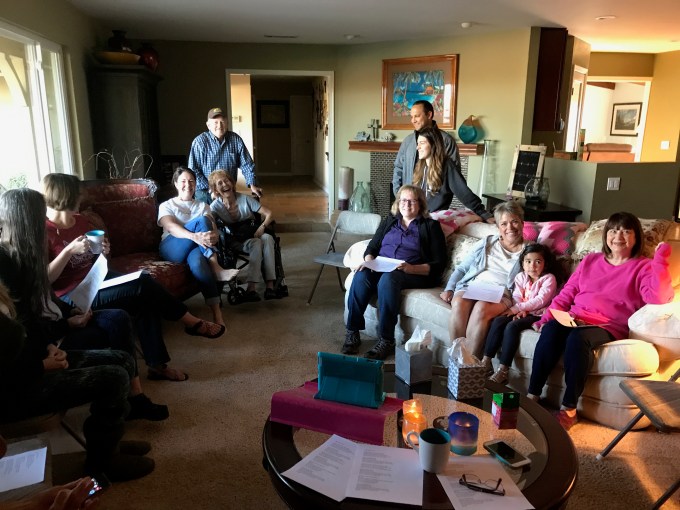
Here is a candid picture taken this morning of our group.  Susan is the lovely lady grabbing her knee, next to dear angel Connie who is beaming with joy. Connie’s husband, Rex, is standing behind her. Diane’s sister, Mary, is front left, with Diane sitting to her right and out of the picture. Next to Mary is recently-joined Ginger. Standing are Susan’s daughter, Stephanie and her husband, Joey. Joey’s mom and prayer warrior, Kelly, is seated beneath Stephanie. On Kelly’s left is sweet Mary, with her young friend and new attendee. Next to her is our dear neighbor, Jan. Unfortunately, some are not in the frame, including Diane, Kiki and Patty (sisters and forces of nature), other Diane (original team captain, now connected via FaceTime on the blue iPad), Susan’s husband, Andy, and Andy’s father, Mark. Regular attender Nancy is out of town, as is Susan’s daughter Drew. This is our Friday morning home.

Christians: A Bad Name?

It’s increasingly common. No. It’s way more than common. In places like coastal California, metropolitan New York, in northeastern enclaves, as well as most of Europe these days … the word Christian at best conjures up a shrug and at worst, a visceral and antagonistic reaction.

Let me qualify that statement. It’s not really the word Jesus that does it to that degree, although it certainly does at times. It’s the concept of Christianity. The concept of people who claim that as their faith.

In many circles, with the so-called educated elite and much of media, the first synonym that probably comes to mind is “hypocrite.” I’m just guessing. I’m also guessing that the next synonym might be “oppression” or “oppressive.”

I’ll say two quick things about that. The first is that these reactions are often completely deserved and appropriately descriptive.

The second is that they are SO off of the mark.

Heck Yes! We Jesus-followers have messed up a great deal. We always have and always will. In that, we’re no different from the followers of every other “religion” and from the followers of those who claim no faith or religion at all. Yes, we’re all the same. We’re all human and very flawed. All of us. There’s not a belief system in the history of our species that is not corruptible by human frailty. Not a one. And, lest we not be clear about this: The claim of no allegiance to a particular belief system because one is either uncommitted or committed to the idea that there is no such thing as a belief system or that the belief system has no room in it for a supernatural being … all of these claims are just plain belief systems. Just like the world’s so-called religions.

Yes, we Jesus-followers … we that sometimes refer to ourselves as Christians … have always struggled with hypocrisy. As has everyone else.

But, and here it gets interesting and I really want to make a point: How many other belief systems completely accept that that’s a problem with us? That we are, indeed, hypocrites? How many other belief systems have at their core two foundational principles: That we love God with everything we have (and I mean everything, not just most things), all the time. And, that we love one another with such complete abandonment that it reflects the same love that Jesus demonstrated time and time again towards everyone he came across, not matter how flawed or broken. Try that on for size. No other belief system commands that high bar. Not a one. Of course, we can’t do it. Really? Think about it. All sorts of belief systems have all sorts of standards but none of them (and I have looked at all of them) has these two at their core. None of them. Of course, we fall short.

Now, we Jesus followers have messed up more ways than we can list here. But, I’ll toss out an obvious one right now. We, far too often, are now being known for what we’re against rather than what we are for. It’s that simple. We make it easy for people to look at us as a curious or even repressive faith. Because that’s not what Jesus taught. He taught that we would be known for the way we loved one another. Not the way we categorized or judged one another as everyone else does. And, believe me, everyone does.

But here’s the deal. The world that sees Christians in this light does not know the Christians I know. If they did, they would be amazed. And not just lightly amazed but completely amazed.

I have been around a lot of people, all of my life, who have done “good” in this world and they represent many different belief systems from agnostic and atheist to adherents of many of the great faith traditions. But, I have never, never met a group who so consistently demonstrates the practice of those two foundational principles. Both of them.

I just spent two full days at a conference with about 4000 Jesus-followers. Nearly all of them were leaders in their faith communities. The median age may have been about 40. I was old. They came from all over and represented many different “denominations” within Christianity and churches with no declared denomination. They did an exercise in the beginning where we all turned on our phone flashlights and were asked to hold them up in the darkened auditorium when our “group” was called. Young. Old. Democrat. Republican. Neither. Californians. Out of state. Out of country. Catholic. Baptist. The list went on. Each time, many, many lights went up.

I have been to many, many conferences and heard many, many speakers. I heard a speaker Friday that was hands down the best speaker I’ve ever heard. He is my hero. I had tears on my cheeks because of the life this man has lived and what he has done to help heal countless thousands of teenage lives in a one of our nation’s most violent and challenging inner cities. Lives that were discarded by their own communities and by a broad society that just doesn’t get it.

I worshipped. Yes, worshipped. That’s an activity where we realize we are not the center of the universe and we give up our ego and the things that diminish us and hand it over in surrender. I can’t help but worship. Well, I worshipped with 4000 other loving people and you just can’t imagine what that’s like unless you’ve participated.

And, here’s the thing about those 4000 people worshipping. They came because they want to change the world. To bless those around them, regardless of their race, their beliefs, their sexuality, their condition. They strive to love God with all they have and to love others as much as they possibly can. And, here’s another thing about those 4000 people. We all know how terribly flawed we are and we struggle on a path towards transformation, knowing all of the time that we will fall short but that’s ok because we know there’s this completely supernatural thing called grace. And, grace is predicated on forgiveness and precedes this thing called redemption which is what we’re all trying to do to heal broken relationships and broken lives.

So, we have a large gathering of mostly young(er) people. Representing all kinds of diversity but believing in unity. Actually, the theme of the conference was Uncommon Fellowship, which is another way of saying that it’s rare for diverse people to come together as unified. Fellowship is a concept not to be trivialized. Fellowship is connection and belonging. It’s a bonding that is inviting and giving and forgiving and blessing all rolled into one. While we may have different ideas about “means” when it comes to things political, for instance, we do not have different ideas about the cause or purpose to which we are called. There is virtually no ambiguity about that. Think about it.

If there was anger present, it was not in evidence. I can’t imagine. On the other hand, there was unbelievable hope. Slow to anger, quick to hope. Slow to judge, quick to love.

I know people who look at me and think or say, “Well, I’m glad you found something to believe in, something that is good for you.” Sometimes, I feel I’m kind of a curiosity. I expect some of these people wonder how I can “belong” to a belief system that is full of hypocrisy. Don’t I see it?

Of course, I see it. Doesn’t everyone see it in their own lives? If not, I am sorry.

Here’s what I hope for. That everyone understands the source of love and the nature of grace. They are not chemical and there is nothing random or accidental about them. Try.

That everyone can surrender the claim that they are either too flawed to be loved deeply or that they do not need it or need to seek it. That everyone can see beyond a narrow prism of the cause de jour (as important and relevant as they may be) to discover a transcendent cause that gives meaning and purpose to all other causes.

That everyone can learn to surrender pride and judgment on occasion and fall to their knees in abject worship, as bizarre as that may sound.

I hope for these things.

And, here’s what I know. That people who think that Christianity is doomed in the face of so called enlightened realities are sadly mistaken. That people who think that Christians are bigoted and given to purveying mythologies or oppressive structures are sadly missing the point. So, do atheists, Buddhists, Hindus, Muslims, agnostics, hedonists, materialists, naturalists and on and on.

Here’s what I know. I see thousands … millions and more … who believe that we are called to love God and others as our primary purpose and cause. Period. And, we can’t do that alone because we are inherently so flawed. But, when we invite grace in and extend grace outward, all things are possible. And that grace has a name. Believe it or not.

Here’s what I know. It would be hard to imagine anyone, regardless of belief, who had sat through those two days who could not have gone away profoundly affected and, perhaps, permanently changed.